
Executive Summary
- Proactive credit structuring is essential for student loan portfolios.
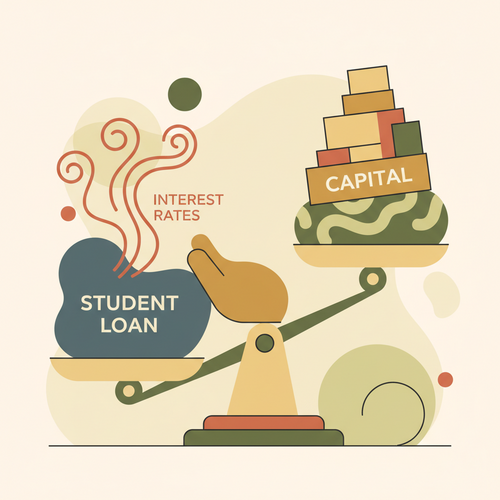
- Strategic financial engineering mitigates interest rate volatility and capital erosion.
- Optimized frameworks enhance long-term portfolio stability and returns.
Understanding Student Credit Risk Exposures
Student loan portfolios inherently carry unique risk profiles. These assets are often long-duration and unsecured. Borrowers typically possess limited credit histories. This amplifies both default risk and prepayment risk.
Interest rate fluctuations significantly impact debt serviceability. Rising rates increase monthly payments. This can strain borrower finances. Concurrently, capital depreciation erodes portfolio value. This occurs through defaults, deferred payments, and adverse market shifts.
Analyzing these exposures requires granular data. Credit analysts must assess borrower demographics. Employment prospects, field of study, and repayment behavior are critical. A comprehensive risk assessment informs robust credit structuring decisions.
Fixed-Rate vs. Variable-Rate Debt: A Deeper Dive
The choice between fixed and variable interest rates is foundational. Fixed-rate loans offer payment stability. Borrowers benefit from predictable monthly outlays. This stability shields them from adverse rate movements. However, fixed rates typically carry a premium. Lenders price in the interest rate risk.
Variable-rate loans often begin with lower initial payments. They track a benchmark index, like SOFR or the Prime Rate. This exposes borrowers to significant payment volatility. Unhedged variable-rate exposures can lead to payment shock. This increases the likelihood of default. Institutions must carefully evaluate their risk appetite.
From an operational standpoint, a balanced portfolio is often optimal. Diversifying between fixed and variable rate exposures can reduce overall portfolio risk. This strategy balances stability with potential yield optimization. Sophisticated modeling informs these critical allocation decisions.
Hedge Instruments and Derivatives for Student Loan Portfolios
Advanced financial instruments provide crucial hedging capabilities. Interest rate swaps are primary tools. These agreements exchange fixed-rate payments for variable-rate payments, or vice versa. Swaps can effectively convert floating-rate debt into synthetic fixed-rate obligations. This stabilizes cash flows for lenders.
Options and futures contracts also mitigate specific risks. Interest rate caps limit upside exposure on variable rates. Floors protect against downside rate movements. Implementing these derivatives requires deep market expertise. Basis risk and counterparty risk must be meticulously managed.
Expert Insight: “In analyzing recent market shifts, financial institutions are increasingly employing portfolio-level hedging strategies. These sophisticated techniques minimize duration mismatch and enhance overall yield curve exposure management.”
The strategic application of these instruments enhances portfolio resilience. It protects against unforeseen interest rate spikes. This ensures capital preservation across economic cycles. Complex financial engineering becomes a competitive advantage.
Structured Repayment Mechanisms: Beyond Amortization
Traditional amortization schedules may not always optimize student loan performance. Innovative repayment mechanisms can enhance portfolio health. Income-Driven Repayment (IDR) plans align payments with borrower earnings. This reduces default rates during periods of financial distress.
Graduated repayment plans offer lower initial payments. Payments then increase over time. This caters to new graduates with lower early career incomes. It improves early-stage loan performance. The structure mitigates immediate payment burdens.
Refinancing and consolidation options also play a role. They allow borrowers to adjust terms and rates. Lenders can offer these products strategically. This retains high-quality borrowers. It also improves overall portfolio credit quality. Tailored solutions enhance borrower retention.
For more detailed information on amortization, consult: https://www.investopedia.com/terms/a/amortization.asp
Capital Preservation Strategies in Educational Financing
Preventing capital depreciation is paramount. This involves rigorous underwriting standards. Comprehensive borrower assessment minimizes initial default risk. Loan-to-value ratios are less applicable in student lending. Instead, income-to-debt ratios become critical metrics.
Diversification across borrower cohorts is also essential. Spreading exposure across different degree types and institutions reduces concentration risk. Geographic diversification further enhances stability. These strategies buffer against localized economic downturns.
Securitization offers another avenue for capital management. Pooling student loans into asset-backed securities (ABS) can distribute risk. It also provides liquidity for originators. Investors assume tranches of risk. This process requires stringent collateral quality controls.
Active portfolio management involves constant monitoring. Early identification of distressed assets is crucial. Proactive intervention strategies include deferment or forbearance. These measures aim to rehabilitate loans. They prevent outright charge-offs, thus preserving capital.
Macroeconomic Factors and Credit Performance Analytics
External macroeconomic forces exert significant influence. Inflationary pressures erode the real value of future payments. Recessions increase unemployment rates. This directly impacts borrower repayment capacity. Understanding these dynamics is vital for portfolio managers.
Central bank monetary policy directly affects interest rates. Quantitative easing or tightening impacts funding costs. This influences loan pricing. Yield curve movements provide forward-looking indicators. A steepening curve often signals economic expansion. An inverted curve may precede a recession.
Sophisticated econometric models forecast these impacts. Predictive analytics identify potential credit deterioration. Early warning systems trigger mitigation strategies. This allows for timely adjustments to credit policies. Data-driven insights are indispensable.
Accessing accurate and timely economic data is crucial. Financial institutions subscribe to premium data services. They employ dedicated macroeconomic research teams. This ensures proactive risk management. It underpins robust strategic decision-making.
Leveraging FinTech Solutions for Optimized Credit Structuring
Financial technology (FinTech) offers transformative capabilities. Artificial intelligence (AI) and machine learning (ML) power advanced underwriting. These algorithms analyze vast datasets. They identify subtle risk patterns traditional methods miss.
Blockchain technology could potentially enhance loan servicing. It offers immutable record-keeping. Smart contracts could automate payment processing. This reduces operational costs. It also improves data integrity and transparency.
Automated portfolio management systems streamline operations. They execute hedging strategies in real-time. These platforms provide immediate insights into risk exposures. They optimize asset allocation dynamically. The integration of FinTech is no longer optional.
These technological advancements facilitate greater efficiency. They enable more precise risk pricing. This leads to better-structured credit products. Ultimately, it optimizes returns for lenders. For more information on interest rate swaps, consider this resource: https://www.investopedia.com/terms/i/interestrateswap.asp
Regulatory Compliance and Risk Mitigation Frameworks
The regulatory landscape for student lending is complex and evolving. Compliance with consumer protection laws is paramount. Regulations like TILA and ECOA dictate disclosure requirements. Adherence prevents significant legal and reputational risks.
Robust internal risk mitigation frameworks are essential. These include comprehensive stress testing protocols. Scenario analysis models adverse economic conditions. It evaluates portfolio resilience under extreme duress. This informs capital adequacy planning.
Internal audit functions independently review processes. They ensure adherence to established policies. Regulatory reporting requirements are stringent. Accurate and timely submissions are mandatory. Non-compliance incurs substantial penalties.
Maintaining strong governance structures is critical. A proactive approach to regulatory changes prevents costly remediation. Continuous training for personnel ensures compliance expertise. This robust framework safeguards institutional integrity.
Conclusion
Strategic student credit structuring demands continuous vigilance. Mitigating interest volatility and capital depreciation requires sophisticated tools. Proactive financial engineering enhances portfolio stability. Deep analytical capabilities drive optimal outcomes.
Institutions must embrace advanced hedging instruments. They should leverage FinTech innovations. Robust risk management frameworks are indispensable. These strategies protect assets and maximize long-term returns. How will your institution adapt its credit structuring for future market challenges?