
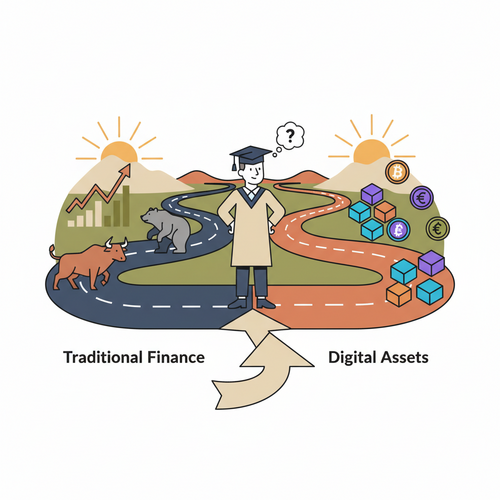
Executive Summary: Navigating Asset Classes
- ✅ Market Volatility: Digital assets exhibit significantly higher price swings than traditional equities.
- 📈 Regulatory Oversight: Established stock markets operate under robust and centralized federal frameworks.
- 🎯 Strategic Allocation: Graduates must balance high-risk speculative growth against stable wealth preservation.
- 🛡️ Information Symmetry: Disclosure requirements in equity markets protect investors from asymmetric risks.
Graduates navigating modern financial markets face a critical dichotomy today. Therefore, mastering the fundamental differences in Cryptocurrencies vs. Traditional Stocks is a professional necessity. Each asset class operates under distinct technological and legal frameworks. These factors directly influence your long-term capital appreciation and risk exposure. Understanding these mechanisms allows for more disciplined fiscal governance throughout your career.
Effective wealth accumulation requires more than just picking winners. It necessitates a deep understanding of market depth and liquidity. Furthermore, investors must recognize how macroeconomic forces impact different valuations. This guide provides the analytical framework needed for sophisticated portfolio management. We will explore the sovereign safety of stocks and the innovative potential of blockchain technology.
Understanding Traditional Equity Markets
Traditional equities represent ownership stakes in publicly traded corporations. These instruments are bought and sold on regulated exchanges like the NYSE. Valuations are typically tethered to company performance and industry trends. In addition, fiduciary duty governs brokerage operations to ensure investor protection. This established system provides a predictable environment for long-term capital growth.
Standard metrics include market capitalization and earnings per share (EPS). Seasoned investors often prioritize companies with strong balance sheets. Regulatory bodies, such as the SEC, enforce stringent compliance standards. This fosters transparency and mitigates systemic risk for the average graduate. Consequently, stocks remain the bedrock of wealth preservation for risk-averse professionals.
The Modern Cryptocurrency Paradigm
In contrast, cryptocurrencies operate on decentralized ledger technology. These digital or virtual currencies use cryptography for security. Bitcoin and Ethereum are the most prominent examples in this space. Their value proposition often stems from technological innovation and network adoption. Disintermediation is a core principle here, bypassing traditional financial intermediaries entirely.
The absence of a central authority is a defining characteristic of crypto. This distributed structure fosters censorship resistance and 24/7 global access. However, it also introduces unique and significant regulatory challenges. Tokenomics and developer activity are critical factors for asset valuation. Market sentiment profoundly influences price action in this nascent ecosystem. Graduates must approach this space with heightened due diligence.
Key Differentiators in Cryptocurrencies vs. Traditional Stocks
Volatility remains the most significant distinction between these two classes. Digital assets are notorious for extreme and sudden price swings. Their speculative nature and nascent market structure contribute to this phenomenon. Beta coefficients for major crypto assets often exceed those of high-growth tech stocks. This amplifies both your potential gains and your total capital risk.
Conversely, traditional stocks exhibit comparatively lower price volatility. Their mature ecosystems and robust investor bases provide greater stability. Liquidity also varies considerably across these different markets. While major crypto assets possess substantial liquidity, smaller altcoins trade with thin order books. This can impact your execution costs for larger trades significantly. Understanding these liquidity spreads is essential for efficient trading.
Regulatory Landscapes and Investor Protection
The regulatory disparity between these asset classes is profound. Stock markets operate under comprehensive legal frameworks that protect consumers. Agencies like the SEC enforce strict reporting requirements for all listed firms. They ensure fair and orderly trading practices for every market participant. Furthermore, fiduciary standards are legally mandated for all financial advisors in this space.
The cryptocurrency space faces an evolving and fragmented regulatory environment. Different jurisdictions adopt varying approaches to digital asset classification. This creates considerable legal uncertainty for the global graduate. Lack of consistent oversight can expose your capital to fraudulent schemes. Understanding securitization is therefore vital for correct asset classification. Always research the legal standing of a platform before committing funds.
Strategic Cryptocurrencies vs. Traditional Stocks Allocation
Effective portfolio management necessitates a disciplined approach to diversification. Integrating both asset classes can offer unique risk-return characteristics. Traditional stocks provide exposure to established and profitable economic sectors. They offer predictable dividend income and historical capital appreciation. For deeper analysis, review our guide on strategic financial planning. This forms the bedrock of your personal balance sheet.
Cryptocurrencies can offer decorrelation benefits to a standard portfolio. Their price movements sometimes show low correlation with traditional equities. This can potentially enhance your portfolio efficiency over time. However, their inclusion requires careful consideration of fixed allocation percentages. A small and strategically managed crypto allocation might suffice for most. Larger allocations suit those with a high risk tolerance and longer horizons.
Navigating Asymmetric Information Risks
In analyzing recent market shifts, we observe a critical factor: asymmetric information. Disclosure requirements in traditional markets aim to level the playing field. In contrast, crypto markets often lack this structured transparency. This demands enhanced due diligence from every professional participant. Recognize information disparities as a significant risk vector for your capital. Operational transparency often dictates long-term investor confidence.
Risk-Adjusted Returns and Long-Term Outlook
Evaluating your investments demands a focus on risk-adjusted returns. Metrics like the Sharpe Ratio provide deeper insights into performance. They compare your returns against the associated volatility or downside risk. Traditional stocks generally offer more consistent risk-adjusted returns over time. This reflects their maturity and fundamental value drivers in the real economy.
Cryptocurrencies present significant drawdown risk despite their meteoric rises. Their long-term viability remains subject to technological adoption and macro forces. Understanding the impact of monetary policy on speculative assets is crucial. Graduates must formulate a robust investment thesis before buying. This requires aligning asset choices with personal financial objectives and risk appetite. Patience remains a paramount virtue in both domains.
The Role of Market Liquidity and Execution
Liquidity refers to the ease of entering or exiting a position. In the stock market, blue-chip equities offer near-instant execution. This is vital during periods of sudden market contraction. In the crypto world, liquidity is highly concentrated in top assets. Exiting a large position in a small altcoin can lead to massive “slippage.” Consequently, your actual profit may be lower than the market price suggests.
Always evaluate the “depth” of the order book before trading. This practice protects your capital from unnecessary frictional costs. Sophisticated graduates use limit orders to control their entry prices. This level of technical discipline separates successful investors from speculators. Continuous education is your best defense against market volatility. Stay informed about liquidity cycles to optimize your exit strategies.
Conclusion: Determining Your Investment Path
Navigating Cryptocurrencies vs. Traditional Stocks demands informed decision-making. Both asset classes offer distinct avenues for long-term wealth accumulation. Your strategic approach should balance growth potential with rigorous risk mitigation. Understand the intrinsic value propositions and market dynamics of each. Diversification remains the cornerstone of sound fiscal planning for graduates. A disciplined investment strategy will serve you well over your career. Continuous learning is the key to mastering these dynamic global markets.